Silk Elements Megasilk Olive Heat Protection Spray Reviews
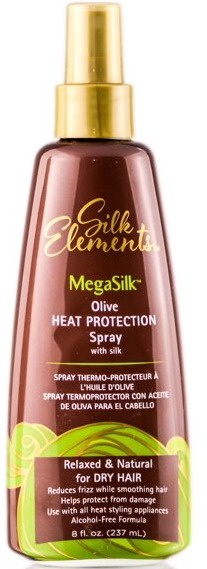
Olive Heat Protection Spray
Protect hair from damage caused by rut styling, leaves hair soft and silky, while providing incredible smoothen.
Uploaded by: arii_aa on
Ingredients overview
Cyclopentasiloxane, Neopentyl Glycol Diethylhexanoate, Amodimethicone, Diisopropyl Adipate, Fragrance, Olea Europaea (Olive) Fruit Oil, Water, Hydrolyzed Silk, Potassium Sorbate, Sodium Benzoate, Alpha-Isomethyl Ionone, Amyl Cinnamal, Benzyl Benzoate, Benzyl Salicylate, Butylphenyl Methylpropional, Citronellol, Linalool, Benzyl Alcohol
Highlights
Key Ingredients
Other Ingredients
Skim through
| Ingredient name | what-information technology-does | irr., com. | ID-Rating |
|---|---|---|---|
| Cyclopentasiloxane | emollient, solvent | ||
| Neopentyl Glycol Diethylhexanoate | emollient | ||
| Amodimethicone | emollient | ||
| Diisopropyl Adipate | emollient, solvent | 0, 0 | |
| Fragrance | perfuming | disgusting | |
| Olea Europaea (Olive) Fruit Oil | antioxidant, emollient, perfuming | 0, 0-two | goodie |
| Water | solvent | ||
| Hydrolyzed Silk | moisturizer/humectant | ||
| Potassium Sorbate | preservative | ||
| Sodium Benzoate | preservative | ||
| Blastoff-Isomethyl Ionone | perfuming | icky | |
| Amyl Cinnamal | perfuming | ||
| Benzyl Benzoate | solvent, perfuming, antimicrobial/antibacterial | icky | |
| Benzyl Salicylate | perfuming | icky | |
| Butylphenyl Methylpropional | perfuming | icky | |
| Citronellol | perfuming | icky | |
| Linalool | perfuming | icky | |
| Benzyl Alcohol | preservative, perfuming, solvent, viscosity controlling |
Megasilk Olive Oestrus Protection Spray
Ingredients explainedA super ordinarily used five unit long, circadian structuredsilicone that is water-thin and does non stay on the skin but evaporates from it (chosen volatile silicone). Similar to other silicones, it gives skin and hair a silky, smooth feel.
It's often combined with the not-volatile (i.eastward. stays on the pare) dimethicone as the 2 together form a water-resistant, breathable protective bulwark on the peel without a negative tacky feel.
 We don't have description for this ingredient yet.
A modified dimethicone-type silicone molecule that as well contains amino-groups. Having amino-groups means that Amodimethicone also has Nitrogen in its molecule that likes to have a positive charge. Positively charged (or quaternised) molecules arenoun to pare and hair equally those are negatively charged surfaces and are excellent film formers. Amodiemthcone is no exception and information technology is particularly recommended for hair-care products for itslong-lasting hair conditioning benefits.
What-it-does: emollient, solvent | Irritancy: 0 | Comedogenicity: 0
A water light oily liquid (aka ester) that has a light pare feeling and is often used to reduce tackiness and lighten the feel of heavier emollients. It's popular in sunscreens to "lighten upwardly" oil soluble chemical UV filters.
Likewise-called: Fragrance, Parfum;Parfum/Fragrance | What-information technology-does: perfuming
Exactly what information technology sounds: squeamish smelling stuff put into cosmetic products so that the end product also smells nice. Fragrance in the Us and parfum in the Eu is a generic term on the ingredient list that is made up of xxx to 50 chemicals on average (but it tin can have as much as 200 components!).
If you lot are someone who likes to know what you put on your face then fragrance is not your all-time friend - there'south no way to know what's actually in it.
Too, if your skin is sensitive, fragrance is again not your best friend. It's the number one cause of contact allergy to cosmetics. It's definitely a smart thing to avoid with sensitive skin (and fragrance of any type - natural is just every bit allergic equally constructed, if not worse!).
You probably know olive oil from the kitchen as a groovy and salubrious option for salad dressing simply it'southward also a swell and healthy selection to moisturize and nourish the skin, especially if it'south on the dry out side.
Similar to other emollient found oils, it'due south loaded with nourishing fatty acids: oleic is the main component (55-83%), and also contains linoleic (iii.v-20%) and palmitic acids (vii-20%). It likewise contains antioxidant polyphenols, tocopherols (types of vitamin E) and carotenoids and it's one of the best plant sources of skin-identical emollient, Squalene.
Too-called: Aqua | What-it-does: solvent
Good old water, aka H2O. The most mutual skincare ingredient of all. Y'all can usually observe it correct in the very kickoff spot of the ingredient list, meaning information technology's the biggest affair out of all the stuff that makes up the product.
Information technology's mainly a solvent for ingredients that practice not similar to dissolve in oils but rather in water.
Once within the skin, it hydrates, but non from the exterior - putting pure water on the skin (how-do-you-do long baths!) is drying.
One more thing: the water used in cosmetics is purified and deionized (it means that almost all of the mineral ions inside it is removed). Like this, the products tin can stay more stable over time.
We don't accept description for this ingredient nonetheless.
It's 1 of those things that help your cosmetics not to become incorrect as well soon, aka a preservative. It's not a potent one and doesn't really work against bacteria, but more than against mold and yeast. To do that information technology has to break downwards to its active form, sorbic acrid. For that to happen, there has to be h2o in the product and the right pH value (pH iii-4).
Only even if everything is right, it'southward non enough on its ain. If you see potassium sorbate yous should encounter some other preservative next to information technology too.
BTW, it'due south too a food preservative and even has an Eastward number, E202.
A helper ingredient that helps to make the products stay overnice longer, aka preservative. It works mainly against fungi.
It's pH dependent and works all-time at acidic pH levels (3-5). Information technology's not strong plenty to be used in itself so information technology's always combined with something else, oft with potassium sorbate.
Information technology's a common fragrance ingredient that is i of the "EU 26 fragrances" that has to be labelled separately (and cannot be simply included in the term "fragrance/perfume" on the characterization) because of allergen potential. Best to avert if your peel is sensitive.
We don't have clarification for this ingredient yet.
A common fragrance ingredient that has a faint sweet balsamic odor. It tin can as well be a solvent and canfight against microbes and insects very well.
Information technology's one of the "EU 26 fragrances" that has to exist labelled separately because ofallergen potential. Best to avoid if your skin is sensitive.
It'south a common fragrance ingredient that has a calorie-free floral smell. It's i of the "EU 26 fragrances" that has to exist labelled separately (and cannot be simply included in the term "fragrance/perfume" on the characterization) considering of allergen potential. Best to avoid if your peel is sensitive.
As well-chosen: Lilial | What-it-does: perfuming
A mutual fragrance ingredient that has a nice floral scent and also goes past the name Lilial. It is a known fragrance allergen and as of 1st of March 2022, it has been banned in the European union due to fauna studies showing a possible link to infertility (in rats - and so no need to panic fifty-fifty if yous used a product before with Butylphenyl Methylpropional).
Citronellol is a very mutual fragrance ingredient with a nice rose-similar odor. In the UK, information technology's really the third near ofttimes listed perfume on the ingredient lists.
It can be naturally found in geranium oil (most 30%) or rose oil (about 25%).
As with all fragrance ingredients, citronellol can also cause allergic contact dermatitis and should be avoided if you have perfume allergy. In a 2001 worldwide study with 178 people with known sensitization to fragrances citronellol tested positive in 5.six% of the cases.
There is no known anti-crumbling or positive skin benefits of the ingredient. Information technology'due south in our products to make information technology odour squeamish.
Linalool is a super common fragrance ingredient. It'due south kind of everywhere - both in plants and in corrective products. Information technology's part of 200 natural oils including lavender, ylang-ylang, bergamot, jasmine, geranium and it tin be establish in 90-95% of prestige perfumes on the market.
The problem with linalool is, that merely like limonene information technology oxidises on air exposure and becomes allergenic. That'due south why a product containing linalool that has been opened for several months is more probable to be allergenic than a fresh ane.
A report made in the UK with 483 people tested the allergic reaction to 3% oxidised linalool and 2.iii% had positive examination results.
It's one of those things that assist your cosmetics not to become incorrect too presently, aka a preservative. It can exist naturally constitute in fruits and teas only can also exist fabricated synthetically.
No matter the origin, in small amounts (up to i%) it'due south a prissy, gentle preservative. Has to be combined with some other nice preservatives, like potassium sorbate to exist broad spectrum plenty.
In loftier amounts, it can exist a skin irritant, only don't worry, it'southward never used in high amounts.
You may also want to take a wait at...
It's a super unremarkably used h2o-thin volatile silicone that gives skin and hair a silky, smooth feel. [more] A modified dimethicone-blazon silicone molecule that as well contains amino-groups. Having amino-groups means that Amodimethicone also has Nitrogen in its molecule that likes to have a positive accuse. [more than] A water white oily liquid (aka ester) that has a low-cal peel feeling and is ofttimes used to reduce tackiness and lighten the experience of heavier emollients The generic term for dainty smelling stuff put into cosmetic products so that the cease product also smells nice. It is made up of thirty to 50 chemicals on average. [more] Olive oil - an oleic acid-rich (55-83%) emollient plant oil that can moisturize dry out skin. Also, it contains antioxidant polyphenols and vitamin E. [more] Normal (well kind of - it's purified and deionized) water. Ordinarily the primary solvent in corrective products. [more] A not and then strong preservative that doesn't really work against bacteria, just more confronting mold and yeast. [more] A preservative that works mainly confronting fungi. Has to be combined with other preservatives. [more than] Information technology's a common fragrance ingredient that is one of the "Eu 26 fragrances" that has to be labelled separately (and cannot be but included in the term "fragrance/perfume" [more than] A common fragrance ingredient that has a faint sweet balsamic smell. It can also be a solvent and tin can fight confronting microbes and insects very well. One of the "Eu 26 fragrances" that has to be labelled separately because of allergen potential. Information technology'due south a common fragrance ingredient that has a light floral aroma. Information technology'southward one of the "European union 26 fragrances" that has to be labelled separately (and cannot be simply included in the term "fragrance/perfume" [more than] A common fragrance ingredient that has a dainty floral smell and also goes by the name Lilial. Information technology is a known fragrance allergen and as of 1st of March 2022, it has been banned in the Eu due to brute studies showing a possible link to infertility (in rats - so no need to panic even if you used a product before with Butylphenyl Methylpropional). [more] A common fragrance ingredient with a dainty rose-like smell. [more] A super mutual fragrance ingredient that can be found among others in lavander, ylang-ylang, bergamot or jasmine. The downside of information technology is that it oxidises on air exposure and might become allergenic. [more] It's ane of those things that aid your cosmetics non to go incorrect too soon, aka a preservative. It can exist naturally plant in fruits and teas but tin also be made synthetically. No matter the origin, in pocket-size amounts (up to one%) it's a nice, gentle preservative. [more]
Source: https://incidecoder.com/products/megasilk-olive-heat-protection-spray
0 Response to "Silk Elements Megasilk Olive Heat Protection Spray Reviews"
Post a Comment